
How Fire Stopping Protects Commercial Buildings
Every commercial building relies on more than sprinklers and alarms to stay safe. At Firestop, we have seen how a single unsealed gap around a pipe or cable can undo an otherwise sound fire safety strategy in seconds. This guide looks at how proper fire stopping protects Melbourne businesses, tenants and property investments, and keeps buildings compliant, insurable and genuinely safe. Fire and smoke can travel through an unsealed gap in minutes, long before anyone notices a problem. Understanding where fire stopping fits into your wider safety plan helps you avoid costly surprises at your next compliance audit.
Table of Contents
Table of Contents
Key Takeaways
- Passive protection, not just alarms, stops fire moving between rooms and floors.
- A sealed penetration restores a wall or floor to its full fire rating.
- Annual inspections and penetration registers keep a building’s compliance current.
- Poor fire stopping can affect insurance cover and delay occupation certificates.
1. Why Passive Fire Protection Matters
Most people think of fire safety as sprinklers, alarms and extinguishers. These active systems detect and fight a fire once it starts. Passive fire protection works differently. It is built into the fabric of the building itself, through fire rated walls, floors, doors and sealed service penetrations, and it works whether or not anyone is present to respond.
Researchers at the University of Queensland’s fire safety programme continue to study how compartment fires behave inside modern open plan buildings, work that underpins the standards Australian fire engineers rely on today. The findings help explain why containing a fire within its compartment of origin, rather than simply detecting it, remains the most reliable way to protect life and property.
2. Fire Stopping of Service Penetrations
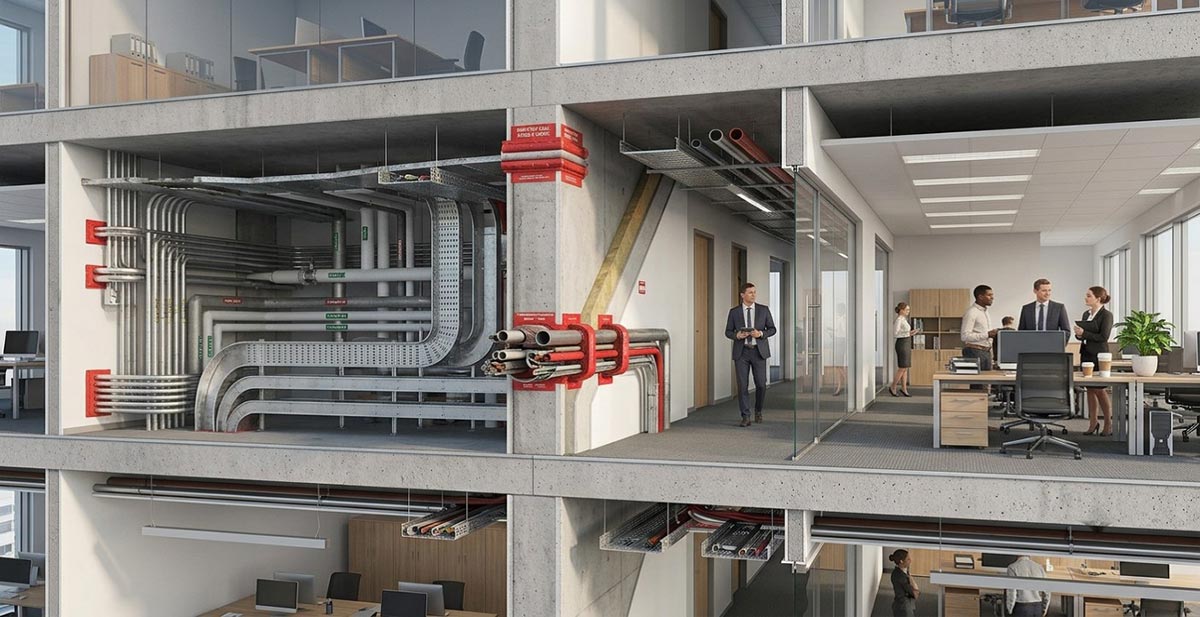
Every time a pipe, cable, duct or conduit passes through a fire rated wall or floor, it creates a gap. Left untreated, that gap becomes a pathway for fire and smoke to travel between compartments within minutes. Our fire stopping of service penetrations service seals these gaps using tested systems, restoring the wall or floor to its original Fire Resistance Level.
All work is carried out to AS1530.4 and AS4072.1, the Australian Standards that set out how fire resistant elements must be tested and installed. Any system installed outside their scope cannot be relied upon in a real fire.
3. Fire Rated Bulkheads and Enclosures
Bulkheads and enclosures do a similar job on a larger scale, closing off risers, shafts and service corridors that would otherwise let fire and smoke bypass compartment walls altogether. Well designed enclosures also help control noise transfer between tenancies, which matters in mixed use commercial buildings where offices sit above retail or hospitality tenants.
4. Compliance, Certification and Penetration Registers
Victoria requires an Annual Essential Safety Measures Report for most commercial buildings, and Fire Rescue Victoria plays a role in assessing fire safety at various stages of a building’s life. A penetration register records every sealed penetration, including the system used and the date of installation, so building owners and certifiers can demonstrate compliance at any time rather than scrambling before an audit.
Independent research highlighted by The Fifth Estate found that close to ninety per cent of Victorian apartment buildings surveyed over a recent year failed to meet fire safety compliance requirements, a reminder that gaps in fire stopping and documentation are common and costly.
5. Inspections and Ongoing Maintenance
Fire stopping is not an install and forget system. Movement, renovations and new cabling can all compromise a seal that was compliant on the day it was installed. Regular inspections and audits catch these issues before they become a liability.
6. The Cost of Getting It Wrong
The consequences of poor fire stopping go well beyond a failed inspection. Insurers increasingly scrutinise passive fire systems as part of underwriting commercial property, and published industry guidance highlights the importance of assessing fire risk from combustible cladding and other building products. Insurance research also notes that fire safety is now a live operational risk throughout a building’s life, with consequences for premiums, claims and director liability, while technical guidance on external wall fire safety demonstrates how complex these assessments have become.
Recent incidents, show how quickly fire can spread through commercial premises once it takes hold. Well maintained fire rated bulkheads and enclosures and sealed penetrations, remain one of the few defences that continue to perform even when everything else fails. Staying up to date with current fire safety guidance also helps building owners remain ahead of changing requirements.
Conclusion
Fire stopping is one of the most cost effective investments a commercial building owner can make, protecting people, property and business continuity long after construction finishes. If your building’s penetrations, bulkheads or fire safety documentation haven’t been reviewed recently, our team can help. A small investment in sealing and certification now can save significant cost, disruption and risk later, whether you manage a single tenancy or a large commercial portfolio. Our licensed technicians know Victorian requirements inside out and can identify gaps before they become genuine hazards. Contact us today for a free consultation and keep your building genuinely protected.
FAQs
What is fire stopping and why do commercial buildings need it?
Fire stopping seals gaps around pipes, cables and ducts in fire rated walls and floors, stopping fire and smoke from spreading between compartments.
How often should fire stopping be inspected?
Most commercial buildings need an annual inspection, though high risk penetrations or recent renovations may call for more frequent checks.
What standards apply to fire stopping in Australia?
Fire stopping systems must comply with AS1530.4 and AS4072.1, the Australian Standards governing fire resistance testing and protected openings.
Can I install fire stopping myself?
No. Fire stopping must be installed by trained technicians using tested systems, or the Fire Resistance Level cannot be guaranteed.
What happens if fire stopping fails an inspection?
A failed inspection means the building may not meet its Annual Essential Safety Measures obligations until defects are rectified.
Does fire stopping affect building insurance?
Yes. Insurers increasingly assess passive fire protection when underwriting commercial property, and poor compliance can affect cover and claims.

